
Our Cottages

Driftwood Cottage, Portsoy
Driftwood Cottage is one of the most charming and photographed cottages in the picturesque coastal town of Portsoy, North East Scotland.

Sandend Cottage, nr Banff
Set in the picturesque ‘get-away-from-it-all’ fishing village of Sandend, between the pretty harbour towns of Cullen and Portsoy on the Moray Firth coast.

No2 Seatown, Lossimouth
The property has been renovated to the latest standards for a new build, underfloor heating from an air source heat pump, P.V. solar panels and battery installation, triple glazed windows throughout and the addition of a mechanical ventilation and heat recovery system.

No6 Seatown, Lossiemouth
6 Seatown is a traditional fisherman’s cottage, built in the 1830s, gable end to the sea, in the oldest part of Lossiemouth, the old Seatown. 6 Seatown provides comfortable and cosy accommodation in a stunning location, just opposite the photogenic remains of the old bridge to the fabulous East Beach and an easy walk to the woods along the river’s edge.

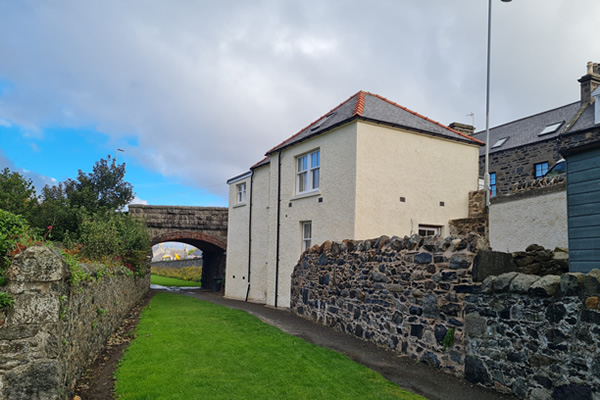
Old Police Station, Portsoy
From the front, it looks tiny! But as you enter from Church street, you will be surprised by how light, bright and spacious this new holiday cottage is! The house is split level, as it backs on to the open space of the Wally Green park and the footpath down the old railway line. Comfortably sleeping 4, the living area is at street level, with a king size double ensuite and a twin bedroom downstairs.
There’s something about the scale of this place, the North East of Scotland, between the mountains and the sea. You can roam for miles across great estates, expanses of moorland, ancient Caledonian forests, rolling farmland, vast dunes, wide sandy beaches and expansive coastlines. History is writ large here too. Ancient sites and symbols mark this as a heartland of the ancient Picts. In the millennia that followed, no fewer than 300 castles were planted here. And of course this majestic place has long been loved by monarchs … and by the salmon that return each year to power upstream in the fast-flowing snow-fed waters of the Dee, the Don and the Spey. It’s a place of big skies and wide horizons, loved for its fresh clear air and the quality of its light. “The Northern sky is a beautiful thing” says Burt Lancaster in cult movie Local Hero, filmed along this coast. In summer, the light up here is special, days are near endless, sunsets stretch out, darkness is brief. In winter, nights are deep and long and starry – and on occasion spectacularly lit by the Northern Lights. You can still hear words from an original Scots language – Doric – and feel its distinctive culture alive in its genial “couthie” people and its “affa fine” traditions – not least the fiddle-playing, the bothy ballads and the highland gatherings. Doric is in the warp and weave of this self-reliant place … a place that’s used to being off the tourism track, known rather as a seat of learning and for its natural resources – its granite, its oil, its fish, its beef, and its whisky.
All is sea and sky at first. Then sandy bays and rugged cliffs come into view, with a string of little seaside towns and villages. The Moray Firth coast is one of the world’s outstanding coastlines, says the National Geographic. Not just for its natural beauty with plentiful wildlife – there are dolphins, seals, puffins and other seabirds in abundance – but for its “strong community feeling”. And the two are surely linked. For right around the coast nature dominates … and people have always pulled together to get things done. Tiny beautifully preserved 17th, 18th and 19th century harbours have rich histories of Baltic trade and herring fleets. Fishing villages perch on clifftops or crouch precariously at the water’s edge, the oldest houses built gable-end on to the weather and the waves. Many with lighthouses to guide safe passage. There’s evidence of older history too. Burghead fort was one of the earliest power centres of the Picts. Craggy clifftops, great dunes and wide beaches stretch for miles, and shifting sands at Culbin where a small farming township was lost during the 17th century. Among the ancient coastal sites are Findlater Castle, open to the elements, with precipitous drops to the sea below. The old ways are still valued: traditional boats still built, crafts thrive, Doric words are spoken and Doric ballads are sung. The people – whether born here or more recently arrived – seem rooted and shaped by this far-flung, salty aired place.
From the Blog
Christopher Nolan’s Odyssey showcases the North East of Scotland
Christopher Nolan’s ‘The Odyssey’ premiered on July 17, boasting an all-star cast with Anne Hathaway, Tom...
Fancy a boat trip?
Fancy a Boat Trip? Seeing some of the approximately 600 Moray Firth Bottlenose dolphins may be on the...
Night Skies and Northern Lights
It's that time of year again. The days are shorter than the nights. Just perfect for cosying up in front of...